
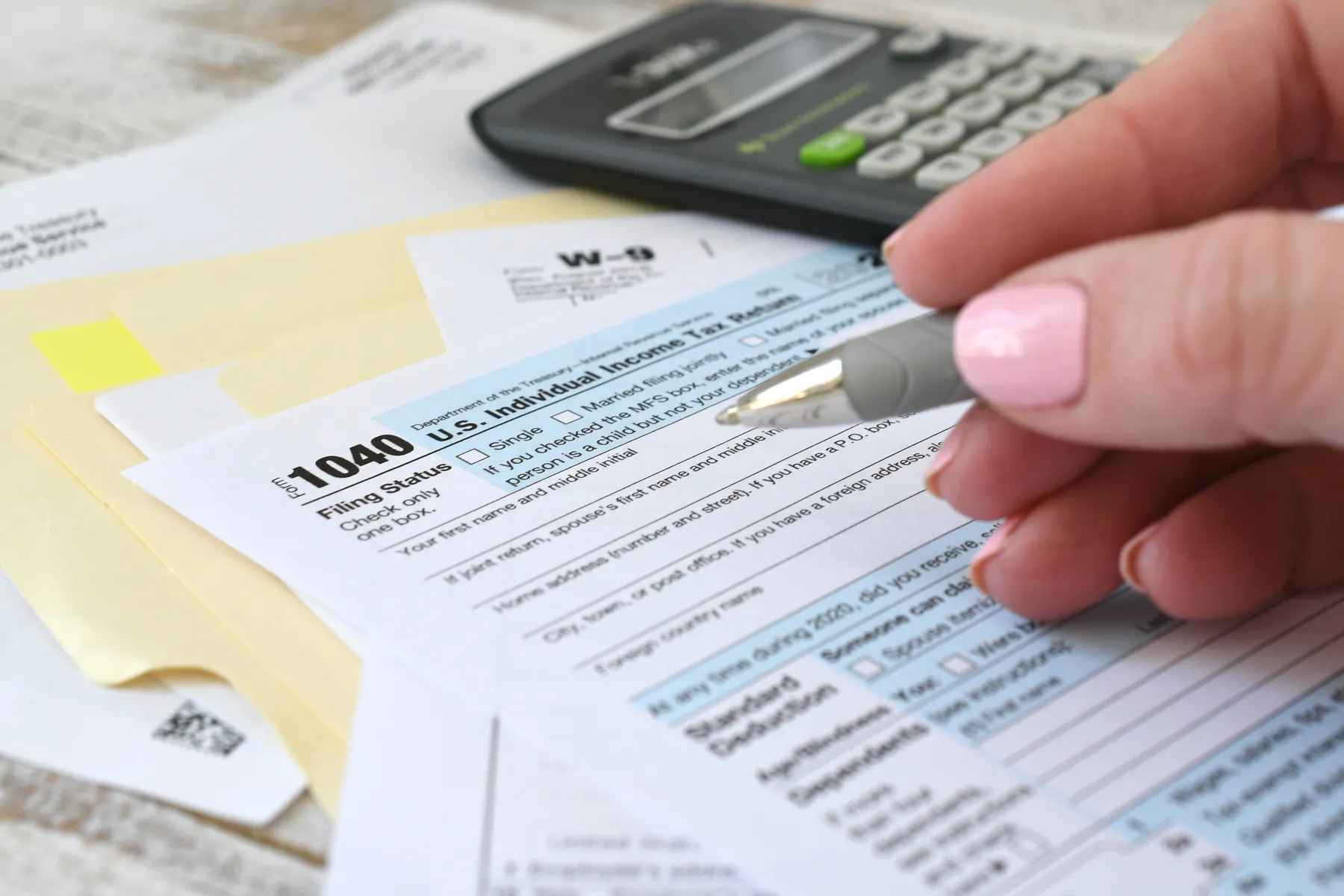
You apply as an individual
The IRS says it plainly on its online payment agreement page: if you are a sole proprietor or independent contractor, apply for a payment plan as an individual. Your business profit is reported on Schedule C of your own Form 1040, so the balance is a personal income tax and self-employment tax balance.
That puts you on the simpler track. An individual who owes $50,000 or less in assessed tax, penalties and interest can get a Simple Payment Plan (formerly the streamlined installment agreement) with no financial statement. The business limits, and the rule that businesses cannot apply online, apply to entities with their own returns and to employers with payroll tax balances.
| Your situation | How you apply | Simple Payment Plan limit |
|---|---|---|
| Sole proprietor or contractor, income tax and self-employment tax only | As an individual, online | $50,000 or less |
| Single-member LLC with no election, no employees | As an individual, online | $50,000 or less |
| Sole proprietor with employees and unpaid payroll taxes | By phone at 800-829-4933 | $25,000 or less for trust fund taxes |
| Out-of-business sole proprietorship with trust fund taxes | By phone | $50,000 or less |
| S corporation or partnership balance | By phone | $50,000 or less without trust fund taxes |
Why self-employed balances build up
Nobody withholds tax from a self-employed person's income. The system expects four estimated payments a year, covering both income tax and self-employment tax. Miss them in a good year and the April bill includes the whole year's tax plus an underpayment penalty. Then the next year's estimates are due while you are still paying the last one. Our guide to self-employment tax explains why the bill is larger than most new owners expect.
The condition that breaks plans: current-year tax
Every payment plan and every offer in compromise requires you to stay current. For the self-employed, that means making this year's estimated payments while paying the plan. A new balance on next April's return defaults the agreement that was covering the old years.
So the monthly figure to budget is the plan payment plus the estimate, not the plan payment alone. If the two together are not affordable, a smaller plan payment backed by a financial statement is better than a plan that fails in its first year.
- 1.Work out this year's expected profit and the estimated tax on it. See quarterly estimated taxes for self-employed owners.
- 2.Set money aside for the estimate from each payment you receive.
- 3.Only then decide what plan payment you can keep every month.
- 4.Make at least one current estimated payment before you apply, so the account shows you are in compliance.
An offer in compromise has the same rule in writing: the IRS lists "made all required estimated payments" among the conditions for eligibility.
Penalty relief for a self-employed filer
From summer 2026 the IRS applies the Automatic Exemption from Penalty to 2025 and later returns when the same return type was filed and paid timely for the three prior years. It covers the failure-to-file and failure-to-pay penalties. It does not cover the estimated tax penalty, and an estimated tax penalty in an earlier year does not count against your record. Details are on the Automatic Exemption from Penalty.
Records a self-employed person needs for a Form 433
If you owe more than $50,000, or cannot afford the payment a Simple Payment Plan requires, the IRS asks for a collection information statement. For the self-employed it asks about the business as well as the household.
- A profit and loss statement for the current year, and for the prior year if the return is not filed
- Business and personal bank statements, usually the last three months
- Accounts receivable: who owes you and how much
- Business equipment and vehicles, with values and loan balances
- Business credit cards and lines of credit
- Proof of household expenses: housing, utilities, vehicle, health insurance
- Proof of this year's estimated tax payments
If your returns are behind
Self-employed people are the group most likely to have unfiled years, because there is no employer filing on a schedule to prompt them. When the IRS prepares a return for you, it uses the 1099s it holds and allows no business expenses. Filing your own return with real expenses usually lowers the balance, sometimes by a lot. See Fresh Start with unfiled returns.
Where we come in
Many self-employed people who owe $50,000 or less can set up a Simple Payment Plan online themselves for the IRS setup fee alone. Our work is the part underneath: reconstructing records where they are missing, preparing unfiled returns with the expenses the IRS left out, reading the transcripts for every open year, preparing the Collection Information Statement with its documents, and explaining in writing which options the numbers support. We give you a scope and a price in writing before anything starts.
Figures on this page were checked against the IRS and Massachusetts sources listed alongside on October 1, 2026. They change — confirm the current amount before relying on one.
General information for owner-led businesses, not advice for your specific situation. Tax and accounting rules change, and how they apply depends on facts particular to your business. Talk to us — or to another qualified professional — before acting on anything here.